
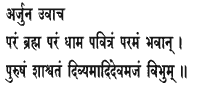
Arjuna said: Thou art the supreme Brahman, the supreme Abode, the supreme Purity, the one permanent, the divine Purusha, the original Godhead, the Unborn, the all-pervading Lord.
The Process of Avatarhood
Sri Aurobindo
WE SEE that the mystery of the divine Incarnation in man, the assumption by the Godhead of the human type and the human nature, is in the view of the Gita only the other side of the eternal mystery of human birth itself which is always in its essence, though not in its phenomenal appearance, even such amiraculous assumption. The eternal and universal self of every human being is God; even his personal self is a part of the Godhead, mamaiva¯m˙ s´ah. ,—not a fraction or fragment, surely, since we cannot think of God as broken up into little pieces, but a partial consciousness of the one Consciousness, a partial power of the one Power, a partial enjoyment of world-being by the one and universal Delight of being, and therefore in manifestation or, as we say, in Nature a limited and finite being of the one infinite and illimitable Being. The stamp of that limitation is an ignorance by which he forgets, not only the Godhead from which he came forth, but the Godhead which is always within him, there living in the secret heart of his own nature, there burning like a veiled Fire on the inner altar in his own temple-house of human consciousness. He is ignorant because there is upon the eyes of his soul and all its organs the seal of that Nature, Prakriti, Maya, by which he has been put forth into manifestation out of God’s eternal being; she has minted him like a coin out of the precious metal of the divine substance, but overlaid with a strong coating of the alloy of her phenomenal qualities, stamped with her own stamp and mark of animal humanity, and although the secret sign of the Godhead is there, it is at first indistinguishable and always with difficulty decipherable, not to be really discovered except by that initiation into the mystery of our own being which distinguishes a Godward from an earthward humanity. In the Avatar, the divinely-born Man, the real substance shines through the coating; the mark of the seal is there only for form, the vision is that of the secret Godhead, the power of the life is that of the secret Godhead, and it breaks through the seals of the assumed human nature; the sign of the Godhead, an inner soul-sign, not outward, not physical, stands out legible for all to read who care to see or who can see; for the Asuric nature is always blind to these things, it sees the body and not the soul, the external being and not the internal, the mask and not the Person. In the ordinary human birth the Nature-aspect of the universal Divine assuming humanity prevails; in the incarnation the God-aspect of the same phenomenon takes its place. In the one he allows the human nature to take possession of his partial being and to dominate it; in the other he takes possession of his partial type of being and its nature and divinely dominates it. Not by evolution or ascent like the ordinary man, the Gita seems to tell us, not by a growing into the divine birth, but by a direct descent into the stuff of humanity and a taking up of its moulds. But it is to assist that ascent or evolution the descent is made or accepted; that the Gita makes very clear. It is, we might say, to exemplify the possibility of the Divine manifest in the human being, so that man may see what that is and take courage to grow into it. It is also to leave the influence of that manifestation vibrating in the earth-nature and the soul of that manifestation presiding over its upward endeavour. It is to give a spiritual mould of divine manhood into which the seeking soul of the human being can cast itself. It is to give a dharma, a religion,—not a mere creed, but a method of inner and outer living,—a way, a rule and law of self-moulding by which he can grow towards divinity. It is too, since this growth, this ascent is no mere isolated and individual phenomenon, but like all in the divine world-activities a collective business, a work and the work for the race, to assist the human march, to hold it together in its great crises, to break the forces of the downward gravitation when they grow too insistent, to uphold or restore the great dharma of the Godward law in man’s nature, to prepare even, however far off, the kingdom of God, the victory of the seekers of light and perfection, sa¯dhu¯na¯m, and the overthrow of those who fight for the continuance of the evil and the darkness. All these are recognised objects of the descent of the Avatar, and it is usually by his work that the mass of men seek to distinguish him and for that that they are ready to worship him. It is only the spiritual who see that this external Avatarhood is a sign, in the symbol of a human life, of the eternal inner Godhead making himself manifest in the field of their own human mentality and corporeality so that they can grow into unity with that and be possessed by it. The divine manifestation of a Christ, Krishna, Buddha in external humanity has for its inner truth the same manifestation of the eternal Avatar within in our own inner humanity. That which has been done in the outer human life of earth, may be repeated in the inner life of all human beings. This is the object of the incarnation, but what is the method? First, we have the rational or minimising view of Avatarhood which sees in it only an extraordinary manifestation of the diviner qualities moral, intellectual and dynamic by which average humanity is exceeded. In this idea there is a certain truth. The Avatar is at the same time the Vibhuti. This Krishna who in his divine inner being is the Godhead in a human form, is in his outer human being the leader of his age, the great man of the Vrishnis. This is from the point of view of the Nature, not of the soul. The Divine manifests himself through infinite qualities of his nature and the intensity of the manifestation is measured by their power and their achievement. The vibhu¯ ti of the Divine is therefore, impersonally, the manifest power of his quality, it is his outflowing, in whatever form, of Knowledge, Energy, Love, Strength and the rest; personally, it is the mental form and the animate being in whom this power is achieved and does its great works. A pre-eminence in this inner and outer achievement, a greater power of divine quality, an effective energy is always the sign. The human vibhu¯ ti is the hero of the race’s struggle towards divine achievement, the hero in the Carlylean sense of heroism, a power of God in man. “I am Vasudeva (Krishna) among the Vrishnis,” says the Lord in the Gita, “Dhananjaya (Arjuna) among the Pandavas, Vyasa among the sages, the seerpoet Ushanas among the seer-poets,” the first in each category, the greatest of each group, the most powerfully representative of the qualities and works in which its characteristic soul-power manifests itself. This heightening of the powers of the being is a very necessary step in the progress of the divine manifestation. Every great man who rises above our average level, raises by that very fact our common humanity; he is a living assurance of our divine possibilities, a promise of the Godhead, a glow of the divine Light and a breath of the divine Power. It is this truth which lies behind the natural human tendency to the deification of great minds and heroic characters; it comes out clearly enough in the Indian habit of mind which easily sees a partial (am˙ s´a) Avatar in great saints, teachers, founders, or most significantly in the belief of southern Vaishnavas that some of their saints were incarnations of the symbolic living weapons of Vishnu,—for that is what all great spirits are, living powers and weapons of the Divine in the upward march and battle. This idea is innate and inevitable in any mystic or spiritual view of life which does not draw an inexorable line between the being and nature of the Divine and our human being and nature; it is the sense of the divine in humanity. But still the Vibhuti is not the Avatar; otherwise Arjuna, Vyasa, Ushanas would be Avatars as well as Krishna, even if in a less degree of the power of Avatarhood. The divine quality is not enough; there must be the inner consciousness of the Lord and Self governing the human nature by his divine presence. The heightening of the power of the qualities is part of the becoming, bhu¯ tagra¯ma, an ascent in the ordinary manifestation; in the Avatar there is the special manifestation, the divine birth from above, the eternal and universal Godhead descended into a form of individual humanity, ¯atm¯ana ˙ m sr. j¯ami, and conscious not only behind the veil but in the outward nature. There is an intermediary idea, a more mystical view of Avatarhood which supposes that a human soul calls down this descent into himself and is either possessed by the divine consciousness or becomes an effective reflection or channel of it. This view rests upon certain truths of spiritual experience. The divine birth in man, his ascent, is itself a growing of the human into the divine consciousness, and in its intensest culmination is a losing of the separate self in that. The soul merges its individuality in an infinite and universal being or loses it in the heights of a transcendent being; it becomes one with the Self, the Brahman, the Divine or, as it is sometimes more absolutely put, becomes the one Self, the Brahman, the Divine. The Gita itself speaks of the soul becoming the Brahman, brahmabhu¯ ta, and of its thereby dwelling in the Lord, in Krishna, but it does not, it must be marked, speak of it as becoming the Lord or the Purushottama, though it does declare that the Jiva himself is always Ishwara, the partial being of the Lord, mamaiva¯m˙ s´ah. . For this greatest union, this highest becoming is still part of the ascent; while it is the divine birth to which every Jiva arrives, it is not the descent of the Godhead, not Avatarhood, but at most Buddhahood according to the doctrine of the Buddhists, it is the soul awakened from its present mundane individuality into an infinite superconsciousness. That need not carry with it either the inner consciousness or the characteristic action of the Avatar. On the other hand, this entering into the divine consciousness may be attended by a reflex action of the Divine entering or coming forward into the human parts of our being, pouring himself into the nature, the activity, the mentality, the corporeality even of the man; and that may well be at least a partial Avatarhood. The Lord stands in the heart, says the Gita,—by which it means of course the heart of the subtle being, the nodus of the emotions, sensations, mental consciousness, where the individual Purusha also is seated,—but he stands there veiled, enveloped by his Maya. But above, on a plane within us but now superconscient to us, called heaven by the ancient mystics, the Lord and the Jiva stand together revealed as of one essence of being, the Father and the Son of certain symbolisms, the Divine Being and the divine Man who comes forth from Him born of the higher divine Nature,1 the virgin Mother, par¯a prakr. ti, par¯a
m¯ay¯a, into the lower or human nature. This seems to be the inner doctrine of the Christian incarnation; in its Trinity the Father is above in this inner Heaven; the Son or supreme Prakriti become Jiva of the Gita descends as the divine Man upon earth, in the mortal body; the Holy Spirit, pure Self, Brahmic consciousness is that which makes them one and that also in which they communicate; for we hear of the Holy Spirit descending upon Jesus and it is the same descent which brings down the powers of the higher consciousness into the simple humanity of the Apostles. But also the higher divine consciousness of the Purushottama may itself descend into the humanity and that of the Jiva disappear into it. This is said by his contemporaries to have happened in the occasional transfigurations of Chaitanya when he who in his normal consciousness was only the lover and devotee of the Lord and rejected all deification, became in these abnormal moments the Lord himself and so spoke and acted, with all the outflooding light and love and power of the divine Presence. Supposing this to be the normal condition, the human receptacle to be constantly no more than a vessel of this divine Presence and divine Consciousness, we should have the Avatar according to this intermediary idea of the incarnation. That easily recommends itself as possible to our human notions; for if the human being can elevate his nature so as to feel a unity with the being of the Divine and himself a mere channel of its consciousness, light, power, love, his own will and personality lost in that will and that being,—and this is a recognised spiritual status, —then there is no inherent impossibility of the reflex action of that Will, Being, Power, Love, Light, Consciousness occupying the whole personality of the human Jiva. And this would not be merely an ascent of our humanity into the divine birth and the divine nature, but a descent of the divine Purusha into humanity, an Avatar. The Gita, however, goes much farther. It speaks clearly of the Lord himself being born; Krishna speaks of his many births that are past and makes it clear by his language that it is not merely the receptive human being but the Divine of whom he makes this affirmation, because he uses the very language of the Creator, the same language which he will employ when he has to describe his creation of the world. “Although I am the unborn Lord of creatures, I create (loose forth) my self by my Maya,” presiding over the actions of my Prakriti. Here there is no question of the Lord and the human Jiva or of the Father and the Son, the divine Man, but only of the Lord and his Prakriti. The Divine descends by his own Prakriti into birth in its human form and type and brings into it the divine Consciousness and the divine Power, though consenting, though willing to act in the form, type, mould of humanity, and he governs its actions in the body as the indwelling and over-dwelling Soul, adhis.t. h¯aya. From above he governs always, indeed, for so he governs all nature, the human included; from within also he governs all nature, always, but hidden; the difference here is that he is manifest, that the nature is conscious of the divine Presence as the Lord, the Inhabitant, and it is not by his secret will from above, “the will of the Father which is in heaven,” but by his quite direct and apparent will that he moves the nature. And here there seems to be no room for the human intermediary; for it is by resort to his own nature, prakr.tim˙ sva¯m, and not the special nature of the Jiva that the Lord of all existence thus takes upon himself the human birth. This doctrine is a hard saying, a difficult thing for the human reason to accept; and for an obvious reason, because of the evident humanity of the Avatar. The Avatar is always a dual phenomenon of divinity and humanity; the Divine takes upon himself the human nature with all its outward limitations and makes them the circumstances, means, instruments of the divine consciousness and the divine power, a vessel of the divine birth and the divine works. But so surely it must be, since otherwise the object of the Avatar’s descent is not fulfilled; for that object is precisely to show that the human birth with all its limitations can be made such a means and instrument of the divine birth and divine works, precisely to show that the human type of consciousness can be compatible with the divine essence of consciousness made manifest, can be converted into its vessel, drawn into nearer conformity with it by a change of its mould and a heightening of its powers of light and love and strength and purity; and to show also how it can be done. If the Avatar were to act in an entirely supernormal fashion, this object would not be fulfilled. A merely supernormal or miraculous Avatar would be a meaningless absurdity; not that there need be an entire absence of the use of supernormal powers such as Christ’s socalled miracles of healing, for the use of supernormal powers is quite a possibility of human nature; but there need not be that at all, nor in any case is it the root of the matter, nor would it at all do if the life were nothing else but a display of supernormal fireworks. The Avatar does not come as a thaumaturgic magician, but as the divine leader of humanity and the exemplar of a divine humanity. Even human sorrow and physical suffering he must assume and use so as to show, first, how that suffering may be a means of redemption,—as did Christ,—secondly, to show how, having been assumed by the divine soul in the human nature, it can also be overcome in the same nature,—as did Buddha. The rationalist who would have cried to Christ, “If thou art the Son of God, come down from the cross,” or points out sagely that the Avatar was not divine because he died and died too by disease,—as a dog dieth,—knows not what he is saying: for he has missed the root of the whole matter. Even, the Avatar of sorrow and suffering must come before there can be the Avatar of divine joy; the human limitation must be assumed in order to show how it can be overcome; and the way and the extent of the overcoming, whether internal only or external also, depends upon the stage of the human advance; it must not be done by a non-human miracle. The question then arises, and it is the sole real difficulty, for here the intellect falters and stumbles over its own limits, how is this human mind and body assumed? For they were not created suddenly and all of a piece, but by some kind of evolution, physical or spiritual or both. No doubt, the descent of the Avatar, like the divine birth from the other side, is essentially a spiritual phenomenon, as is shown by the Gita’s a¯tma¯nam˙ sr.j ¯ami, it is a soul-birth; but still there is here an attendant physical birth. How then were this human mind and body of the Avatar created? If we suppose that the body is always created by the hereditary evolution, by inconscient Nature and its immanent Life-spirit without the intervention of the individual soul, the matter becomes simple. A physical and mental body is prepared fit for the divine incarnation by a pure or great heredity and the descending Godhead takes possession of it. But the Gita in this very passage applies the doctrine of reincarnation, boldly enough, to the Avatar himself, and in the usual theory of reincarnation the reincarnating soul by its past spiritual and psychological evolution itself determines and in a way prepares its own mental and physical body. The soul prepares its own body, the body is not prepared for it without any reference to the soul. Are we then to suppose an eternal or continual Avatar himself evolving, we might say, his own fit mental and physical body according to the needs and pace of the human evolution and so appearing from age to age, yuge yuge? In some such spirit some would interpret the ten incarnations of Vishnu, first in animal forms, then in the animal man, then in the dwarf mansoul, Vamana, the violent Asuric man, Rama of the axe, the divinely-natured man, a greater Rama, the awakened spiritual man, Buddha, and, preceding him in time, but final in place, the complete divine manhood, Krishna,—for the last Avatar, Kalki, only accomplishes the work Krishna began,—he fulfils in power the great struggle which the previous Avatars prepared in all its potentialities. It is a difficult assumption to our modern mentality, but the language of the Gita seems to demand it. Or, since the Gita does not expressly solve the problem,wemay solve it in some other way of our own, as that the body is prepared by the Jiva but assumed from birth by the Godhead or that it is prepared by one of the four Manus, catv ¯aro manavah., of the Gita, the spiritual Fathers of every human mind and body. This is going far into the mystic field from which the modern reason is still averse; but once we admit Avatarhood, we have already entered into it and, once entered, may as well tread in it with firm footsteps. There the Gita’s doctrine of Avatarhood stands. We have had to advert to it at length in this aspect of its method, as we did to the question of its possibility, because it is necessary to look at it and face the difficulties which the reasoning mind of man is likely to offer to it. It is true that the physical Avatarhood does not fill a large space in the Gita, but still it does occupy a definite place in the chain of its teachings and is implied in the whole scheme, the very framework being the Avatar leading the vibhu¯ ti, the man who has risen to the greatest heights of mere manhood, to the divine birth and divine works. No doubt, too, the inner descent of the Godhead to raise the human soul into himself is the main thing,—it is the inner Christ, Krishna or Buddha that matters. But just as the outer life is of immense importance for the inner development, so the external Avatarhood is of no mean importance for this great spiritual manifestation. The consummation in the mental and physical symbol assists the growth of the inner reality; afterwards the inner reality expresses itself with greater power in a more perfect symbolisation of itself through the outer life. Between these two, spiritual reality and mental and physical expression, acting and returning upon each other constantly the manifestation of the Divine in humanity has elected to move always in the cycles of its concealment and its revelation.
Sri Aurobindo
 About Us| ©1999 - 2009 searchforlight.org
All extracts and quotations from the written works of Sri Aurobindo and the Mother and the Photographs of
the Mother and Sri Aurobindo are copyright Sri Aurobindo Ashram Trust, Pondicherry -605002 India.